
Guide · Editorial
The Florence ZTL, explained: the €83 mistake you can't see
Florence's limited-traffic zone is enforced by cameras, not barriers, and the fine reaches you months later. Where it is, when it's active, and how to avoid it.
Published 27 July 2026 · Updated 27 July 2026 · 11 min read
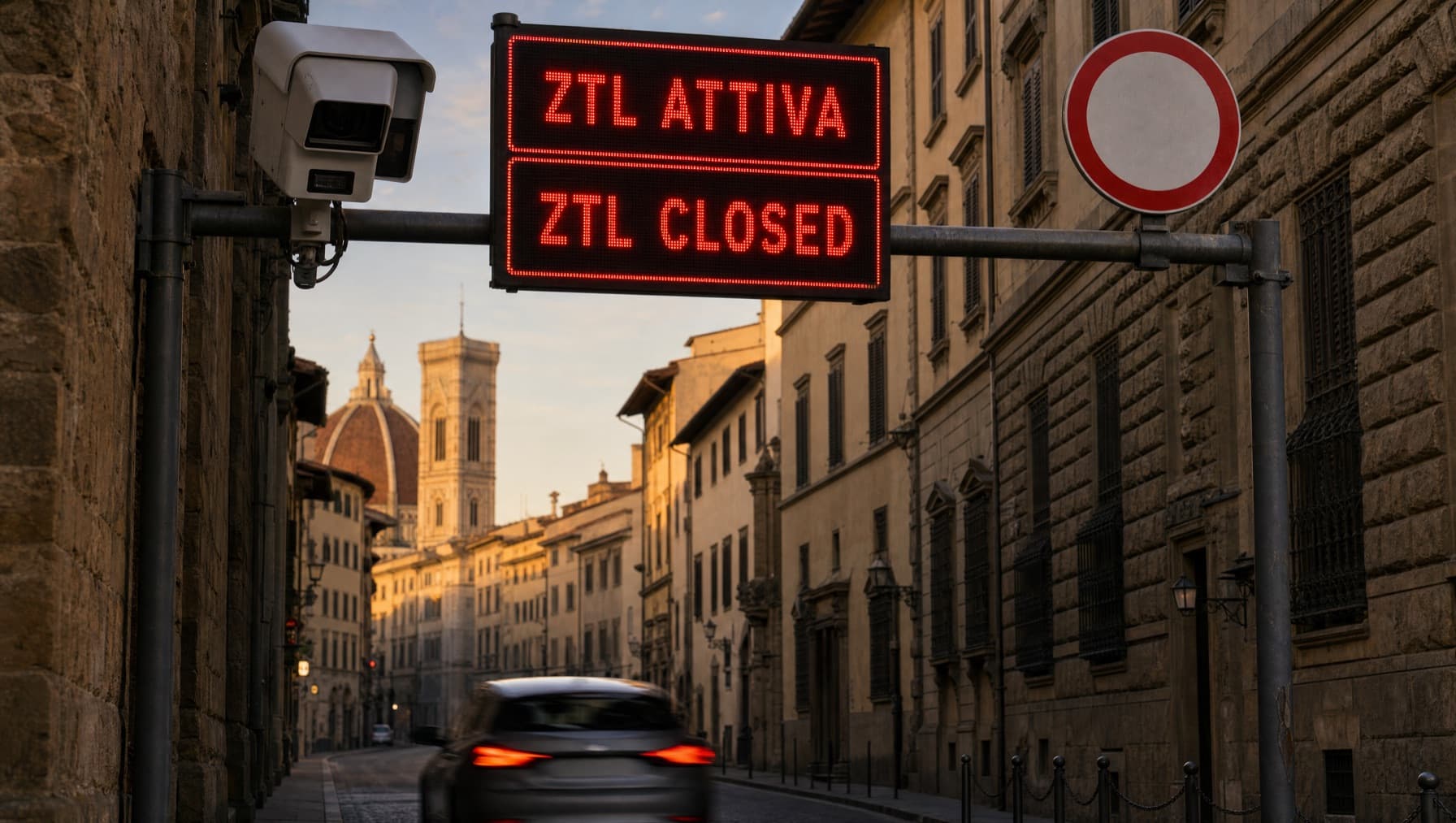
Florence's historic centre is a limited-traffic zone, and the reason it catches so many visitors is that there is nothing to catch. No barrier lifts, no attendant waves you down, no gate blocks the road. There is only a small sign and a camera that reads your plate, and several months later a fine arrives at your home address. That is the whole trap, and this guide exists to keep you out of it: where the zone is, when it is switched on, the one exception that lets you reach a hotel inside it, and where to leave the car instead. And because the rules depend on the clock, this guide includes a live checker: pick your date and time on the map below, and see whether the zone will be active when you drive.
If you are still deciding whether to drive at all, the honest answer is in our getting around Florence guide: you will mostly walk, and the trams and buses cover the rest. Fares live in that guide, so we will not repeat them here.
What the ZTL is, and why cameras
The ZTL, Zona a Traffico Limitato, is a zone where only authorised vehicles may circulate during set hours. Florence's is divided into five sectors: A, B, O, F and G, with A covering the core around the Duomo and Signoria, B the ring out to the viali, and O the Oltrarno across the river (Comune di Firenze; Disciplinare ZTL).
Enforcement is entirely automatic. Each entrance, a varco, carries a camera that photographs the plate of every vehicle passing under it, and the system checks that plate against the list of authorisations (Disciplinare ZTL). Nothing stops you physically, which is precisely why so many drivers sail through convinced they have done nothing wrong. Worth knowing too: some varchi are closed around the clock, reserved for buses and emergency vehicles, whatever the hour (Comune di Firenze).
One more thing not to confuse with the ZTL: since 2025 Florence also runs the Scudo Verde, a much larger environmental zone with its own gates around the city (Comune di Firenze open data). It is a separate scheme with separate rules. It works by vehicle emissions class rather than by permit, so what matters is how old and how polluting your vehicle is; if you are driving an older car, check the Comune's Scudo Verde page before approaching the city. This guide covers the historic-centre ZTL.
The map
This is a live map of Florence's ZTL. Choose a date and time and it shows whether the zone will be active, in red or green. Pedestrian areas stay closed to cars at all times.
Checking Florence time…
ZTL sectors: daytime A, B, O · summer nights add F and G
On summer nights (Thu–Sat, 23:00–03:00) the zone grows: San Niccolò, Piazzale Michelangelo and the southern hills, plus the east river bank near Piazza Piave, are also closed. Official ZTL map (Comune PDF)
ZTL boundary: Comune di Firenze open data (CC BY 4.0), rendered by Florence.City. Night sectors F and G: Comune di Firenze open data ztl_notturna (CC BY 4.0). See the official map. Pedestrian areas: Comune di Firenze open data areepedonali / mobilita:areepedonali (CC BY 4.0).
Read the map this way. The shaded area is the daytime perimeter, the sectors A, B and O that operate on working days. Your rule of thumb is brutally simple: if your route crosses that outline at any point, assume you need authorisation, because crossing it is the violation, not parking inside it. Note that the boundary streets themselves are usually excluded from the zone, so the viali ring road and the lungarni along the Arno can generally be driven, while the streets leading off them into the centre cannot. The summer night zone is larger still: sector F climbs the hills south of the river around Piazzale Michelangelo, and the small sector G runs along the river to the east near Piazza Piave, so a night route that looks clear on this outline may not be. When in doubt, treat the centre as closed and park outside it.
When it is active
The daytime zone runs on working days only:
| Zone | Days | Hours |
|---|---|---|
| Daytime (sectors A, B, O) | Monday to Friday | 07:30–20:00 |
| Daytime (sectors A, B, O) | Saturday | 07:30–16:00 |
| Summer night (all sectors, 2 Apr to 4 Oct 2026) | Thursday, Friday, Saturday nights | 23:00–03:00 |
Sources: Servizi alla Strada for the daytime regime, and Servizi alla Strada for the 2026 night season, set by Giunta resolution 2026/0099 of 27 March 2026. The table is the rule; the checker on the map above applies it to any date and time you pick, including the night season and public holidays.
Two traps hide in that table. First, the summer night ZTL covers all five sectors and runs from 2 April to 4 October 2026 on Thursday, Friday and Saturday nights, from 23:00 to 03:00 the following morning. That means a Saturday night out ends inside a live ZTL at three in the morning on Sunday, so "Sundays are free" is not true for the small hours. Second, the start times for these night closures are set fresh each year and did change for 2026, so guidance you read from an earlier season may be wrong, and even the Comune's own ZTL page still displays dates from 2022. Check the current-year notice, or simply follow the rule that keeps everyone safe: when in doubt, assume the zone is active.
The hotel exception, which is the one that saves people
If your accommodation is inside the zone, you are not stuck. Hotels, guesthouses and B&Bs in the ZTL can put a guest's plate on a temporary "white list" through the city's online system, which authorises the passage; the registration is made by the property, not by you, and the official fee is €1 (Disciplinare ZTL, sheet 4.2). The same sheet permits transit across all sectors by the shortest route to the property, and parking for up to 30 minutes near it with the property's dated card displayed.
What you must do is small and easy to forget: give the property your exact plate, including the country, and confirm that they have actually entered it. The rules do allow a property to regularise a passage shortly after the fact, but the Polizia Municipale is emphatic that access permits generally have to exist before you drive through (Polizia Municipale). So treat the after-the-fact route as an emergency backstop, never as the plan.
Disabled badge holders get access too, but registration is required rather than assumed. Holders of a badge issued elsewhere, including visitors, are told to notify the plate in advance or, obligatorily, within 48 hours of entry, by freephone 800 339891 or by email to upd@serviziallastrada.it, for a period of up to 15 days (Servizi alla Strada). If you are travelling with a non-Italian badge, contact them before the trip rather than relying on the badge alone.
Your navigation app will not save you
The short answer: Google Maps does not warn you about Florence's ZTL, and Waze does, if you set it up. From our own driving around Florence, Google Maps will happily route you straight through the zone, with nothing on screen as you cross the line. Waze knows Italian limited-traffic zones, asks whether you hold a ZTL permit, and if you tell it you do not, it routes around them. In our experience that one setting is the difference between a normal drive and a fine in the post. App behaviour changes with updates, so treat this as a habit check before you drive rather than a guarantee: whatever the app says, the boundary on the map above is the truth.
If you got a fine

First, the numbers. Entering a limited-traffic zone without authorisation is penalised under Article 7 of the Codice della Strada at €83 to €332 (Normattiva), and the Comune describes its own ZTL notices as €83 per unauthorised passage (Comune di Firenze). Payment at the minimum is possible within 60 days of notification, reduced by 30% if you pay within 5 days, with notification costs added on top (Normattiva; Polizia Municipale).
Then the part that surprises people. Each unauthorised passage through a gate is its own violation of Article 7, so a single confused loop through the centre, in and out and in again, can produce more than one notice rather than a single fine for the day. And the wait is long: for a person resident abroad, the authorities have up to 360 days to notify the violation (Normattiva, art. 201). Nearly a year of silence is not evidence that you got away with it.
With a rental car, the chain works like this: the renter, not the rental company, is the party jointly liable with the driver under the highway code (Normattiva, arts. 196 and 84), which is why the company identifies you to the authority and the notice is redirected to your home address. The company will also charge its own administration fee for handling it, set by your rental contract rather than by law. Florence outsources the handling of fines for people abroad, with a multilingual portal and phone line for payment and for viewing the photographic evidence (Polizia Municipale). If you believe a notice is wrong, there are formal appeal routes to the Prefetto or the Giudice di Pace with their own deadlines (Polizia Municipale); we can point you to them, but this is not legal advice, and a lawyer is the right call if the notice matters.
Park here instead
The single most useful fact in this guide: every Firenze Parcheggi garage has its entrances and exits positioned outside the ZTL camera gates, which the operator states plainly (Firenze Parcheggi). Drive straight to one and you cannot pick up a ZTL fine on the way in. There are fifteen of them, including the station, San Lorenzo, Sant'Ambrogio, Beccaria, the Parterre, Porta al Prato and Oltrarno-Calza. Rates are set per garage: the station garage charges €4.00 for the first hour and €4.00 per hour thereafter, and the Oltrarno-Calza garage €3.00, and note that several central garages, including those two, have no daily flat rate (Firenze Parcheggi; Firenze Parcheggi). For a full day, that adds up.
For a full day, the better play is the Villa Costanza park-and-ride. It sits directly on the A1 motorway with its own toll gate between the Scandicci and Impruneta exits, so you reach it without ever entering city traffic, and the T1 tram terminus is a few steps from the car park, about 22 minutes from Santa Maria Novella. Parking is free for the first 15 minutes, €0.50 up to an hour, €2 for 1 to 4 hours, €5 for 4 to 10 hours and €7 for 10 to 24 hours, and the car park is open around the clock (Villa Costanza). One caveat the operator states clearly: the tram ticket is not included in the parking price, so buy it at the machines in the car park.
On the street outside the zone, colour tells you the rule. White lines are reserved for residents, blue lines are paid for non-residents (and are also used for fast-rotation bays), and yellow lines are for disabled badge holders (Comune di Firenze). Because blue covers more than one regime in Florence, read the sign at the bay rather than assuming a single tariff.
The summer night zone is worth one last thought if you are visiting in the warm months, when evenings run late and the centre closes again at 23:00 on the busiest nights: see August in Florence for how the city moves in high summer. And for everything else on wheels, rails and foot, our getting around guide is the anchor. Both sit with the rest of our Florence guides.
Frequently asked questions
- What is the ZTL in Florence?
- The ZTL (Zona a Traffico Limitato) is Florence's limited-traffic zone, covering the historic centre in sectors A, B and O, plus sectors F and G at night in summer. There are no barriers: automatic cameras at each entrance read your plate, and an unauthorised passage becomes a fine by post (Comune di Firenze; Servizi alla Strada).
- How much is a Florence ZTL fine?
- Driving into a limited-traffic zone without authorisation carries an administrative penalty of €83 to €332 under Article 7 of the Italian highway code, and the Comune describes its ZTL notices as €83 per unauthorised passage. Paying within 5 days of notification reduces it by 30%, and there are notification costs on top (Normattiva; Comune di Firenze).
- Can I drive to my hotel inside the ZTL?
- Yes, if the hotel registers your plate. Accommodation inside the zone can enter a guest's plate on a temporary 'white list' through the city's online system, which authorises the passage. Give your hotel the exact plate and country before you drive in, and confirm they have done it. Do not rely on fixing it afterwards (Servizi alla Strada, Disciplinare ZTL).
- Where should I park to visit Florence?
- Outside the gates. Every Firenze Parcheggi garage has its entrances and exits positioned outside the ZTL camera gates, so driving straight into one cannot earn you a ZTL fine. The cheapest option for a full day is the Villa Costanza park-and-ride, reached directly from the A1 motorway, at €7 for 10 to 24 hours, with the tram into the centre (Firenze Parcheggi; Villa Costanza).
- Does Google Maps or Waze warn you about the ZTL in Florence?
- In our experience, Google Maps does not: it will route you through the ZTL without any warning. Waze does know Italian limited-traffic zones, and if you tell it you have no ZTL permit it routes around them. Check that setting before driving, and treat the zone boundary, not the app, as the final word.
- How do I know if the Florence ZTL is active right now?
- Use the live checker on this page: pick any date and time and the map shows whether the zone is active, in red or green, including the summer night season and public holidays. As a rule of thumb, the daytime zone runs on working days, Monday to Friday 07:30 to 20:00 and Saturday 07:30 to 16:00, with Thursday to Saturday nights added in summer.
Sources and freshness
Checked against the official sources below on 27 July 2026.
- Comune di Firenze: ZTL (sectors, hours, structure)Sector layout (A, B, O, F, G) and structure of the zone
- Servizi alla Strada: ZTL rules and activation hoursDaytime hours Mon-Fri 07:30-20:00, Sat 07:30-16:00
- Servizi alla Strada: summer night ZTL 2026 (Giunta resolution 2026/0099)Summer night ZTL dates and hours for 2026
- Disciplinare ZTL: Provv. Dir. 2011/M/04192 (sector perimeters; hotel white list, sheet 4.2)Hotel white-list rule and sector perimeters
- Servizi alla Strada: ZTL access rules for disabled badge holdersDisabled-badge access and 48-hour notification rule
- Normattiva: Codice della Strada (arts. 7, 196, 201, 202)Fine range €83-€332 and notification deadlines
- Polizia Municipale di Firenze: fines information for non-residentsHow non-residents receive and pay ZTL notices
- Firenze Parcheggi (Fipark): garages, all with entrances outside the ZTLCity garages with entrances outside the camera gates
- Parcheggio Villa Costanza: park-and-ride tariffs and tram connectionVilla Costanza park-and-ride tariff
- Comune di Firenze open data: ZTL diurna perimeter (CC BY 4.0)Daytime ZTL perimeter used for the map
- Comune di Firenze: press release, ZTL enforcement (€83 per unauthorised passage)Comune description of notices as €83 per unauthorised passage
- Comune di Firenze open data: Scudo Verde gatesScudo Verde gate locations (separate from the historic-centre ZTL)
- Comune di Firenze: Scudo Verde (environmental ZTL activation)Scudo Verde environmental zone rules