
Guide · Editorial
When to visit Florence
The best time to visit Florence is April–May or September: mild weather, lighter crowds, and the city's biggest festivals. A season-by-season guide.
Published 15 June 2026 · Updated 15 June 2026 · 8 min read
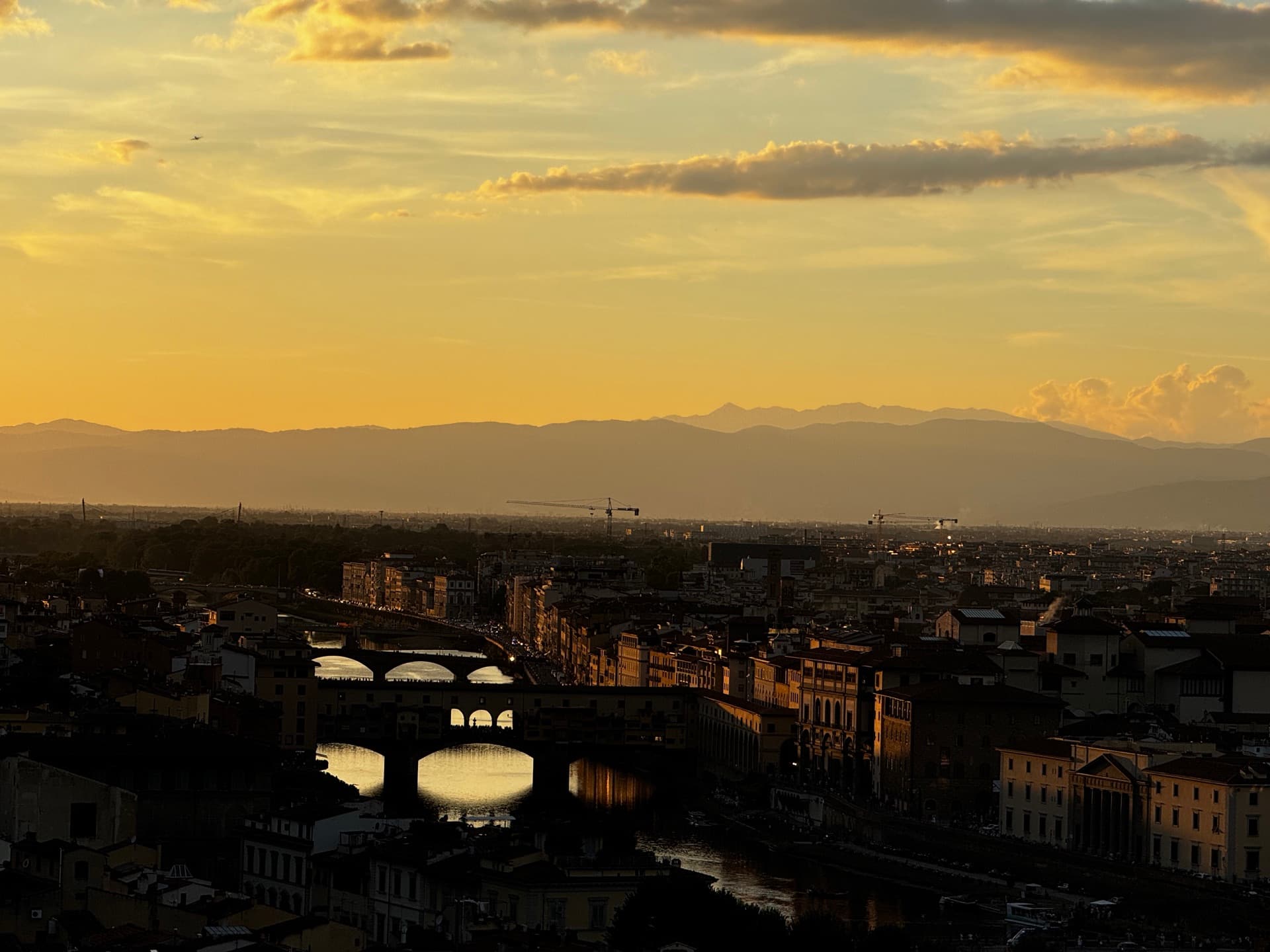
The best months to visit Florence are April–May and September: daytime temperatures sit in the low-to-mid 20s°C, the days are long, and the crowds are thinner than at the July–August peak. If you want one word, pick September — it keeps summer's warmth without summer's heat or queues.
This guide ranks the seasons on the three things that actually decide a Florence trip — weather, crowds, and what's happening — using the official 1991–2020 climate normals for Florence and the city's own event calendar, cited at each number rather than from anyone's single visit. One honest note up front: August is hotter and emptier of locals than people expect, but not quieter overall — the reasons are below.
The short answer: spring and early autumn win
Go in April–May or September–October for the best balance of weather and crowds. These shoulder-season windows give you warm-but-not-hot days, the lowest rain risk outside high summer, and noticeably shorter museum lines than June through August.
Pick your window by priority: late April to mid-June for gardens, festivals, and long evenings; September for the single best all-round month; November to February if your goal is empty museums and low prices and you don't mind grey, short days.
Florence weather, season by season
Florence has a transitional-Mediterranean climate: mild, changeable springs and autumns, hot dry summers, and cool, often-grey winters. Because the city sits inland in a river valley, summers run hotter and winters a touch cooler than the Tuscan coast — its mean annual temperature is 15.5°C (Consorzio LaMMA, 1991–2020 normals).
| Season | Avg daytime high | Rain | Crowds | Best for |
|---|---|---|---|---|
| Spring (Mar–May) | 16 → 24.5°C | Moderate (Apr ~67 mm) | Building, spikes at Easter | Gardens, festivals, mild walking |
| Summer (Jun–Aug) | 29 → 32.5°C; record 41.3°C | Driest (Jul ~26 mm) | Peak (international) | Long days, Calcio Storico — if you tolerate heat |
| Autumn (Sep–Nov) | 27 → 16°C, cooling | Wettest (Oct 104, Nov 118 mm) | Eases after September | Best balance, harvest season |
| Winter (Dec–Feb) | ~11°C, lows near 0°C | Grey; ~821 mm/yr citywide | Lowest (except holidays) | Empty museums, Christmas, low prices |
All figures: Consorzio LaMMA (Florence, 1991–2020 averages).
Spring (March–May): mild, green, and rising
Spring is the prettiest time to walk Florence, but pack for changeable weather. March and early April swing between warm sun and cold rain; by May the city settles into average highs of 24.5°C (Consorzio LaMMA). April is among the rainier spring months at about 67 mm over nine days, so carry a layer (Consorzio LaMMA). This is the window for the gardens — the wisteria at Giardino Bardini and the terraces of Giardino delle Rose are at their best in April and May.
Summer (June–August): hot, dry, and lively
Summer is loud, bright, and genuinely hot, with the city's biggest folk events packed into June. July and August are the hottest months, with average highs of 32.2°C and 32.5°C; Florence records a mean of 24 days a year above 34°C and hit an all-time 41.3°C on 1 August 2017 (Consorzio LaMMA). July is also the driest month, at about 26 mm of rain over three days (Consorzio LaMMA). Plan sightseeing for before 11am, keep the afternoons for shade — the cypress avenues of the Boboli Gardens — and lean on cold defences.
One counterintuitive thing about August: it stays busy with international visitors, but around Ferragosto — the 15 August national holiday — many Florentines leave for the coast and family-run shops and trattorias close for one to two weeks (Wanted in Rome). The city empties of locals, not of tourists. Come in August only if you sightsee early and rest at midday.
The city's top-ranked gelato, by the algorithm:
Gelato in Centro Storico
- Chocolate shop
Venchi Cioccolato & Gelato, Firenze Piazza del Mercato Nuovo, Porcellino, Ponte
Centro Storico · Florence · 4.8 · 9,635 · Google
Autumn (September–November): the quiet winner
September is the best month to visit Florence, full stop. It holds a 20.9°C mean and highs near 27°C while the summer crowds thin out (Consorzio LaMMA). The trade-off arrives later: autumn is the wettest season, with October at 104 mm and November at 118 mm of rain over roughly ten days (Consorzio LaMMA).
Winter (December–February): cold, grey, and empty
Winter is the time to come for the art, not the weather. Average highs sit around 11°C, January is the coldest month at a 6.7°C mean, and nights can dip below freezing — Florence's record low of −10.2°C fell on 30 December 2005 (Consorzio LaMMA). Snow is rare. In return you get the year's lowest crowds outside the Christmas–New Year spike, and the museums that swallow millions of summer visitors feel almost calm.
Cafés in Centro Storico
When Florence's crowds actually peak
Crowds peak from June through August and around Easter, and thin sharply from November. The scale is easy to underestimate: the Uffizi Galleries drew 5,294,968 visitors in 2024, making it Italy's second most-visited state museum behind Rome's Colosseum (~15 million), per the Ministry of Culture's rankings (Florence Daily News). Michelangelo's David at the Galleria dell'Accademia pulled over 2.1 million the same year, ranking fifth nationally (Florence Daily News).
Those numbers land on a small historic centre, which is why timing matters more here than the raw temperature. Whenever you come, book the Uffizi and the Accademia with timed-entry tickets — walk-up lines run two to three hours in season.
Florence's festival calendar, by season
Florence's biggest events cluster in spring and in June, so your dates can be chosen around them. Four anchor the year:
- Scoppio del Carro (Explosion of the Cart) — Easter Sunday, 5 April in 2026. A fireworks-laden cart is set off in Piazza del Duomo around 11am, and it's free to watch (VisitFlorence).
- Maggio Musicale Fiorentino — the opera and classical festival's 88th edition runs 19 April to 1 July 2026 (Italia.it).
- Calcio Storico Fiorentino & Festa di San Giovanni — the historic-football final is on 24 June, the feast of Florence's patron saint, with semifinals on 13–14 June 2026 in Piazza Santa Croce; the San Giovanni fireworks close the night (Comune di Firenze).
- Festa della Rificolona — the lantern festival fills Piazza Santissima Annunziata on 7 September (Comune di Firenze).
For the San Giovanni fireworks on 24 June, the classic vantage is Piazzale Michelangelo above the south bank — arrive early; it fills.
If you can only optimise one thing, optimise the month, not the museum list. The right month makes the whole city easier.
How to choose your dates
Match the month to what you actually want, not to a generic "best time." Use this as a decision shortcut:
- Gardens, mild walking, blossom → April–May. Start with the Oltrarno neighbourhood walk on a clear spring morning, before the afternoon warms.
- Festivals and the longest days → June, timed to Calcio Storico and San Giovanni (24 June).
- The best all-round balance → September: summer warmth, autumn calm.
- Fewest crowds and lowest prices → late November to February, skipping the Christmas–New Year peak.
- Heat-tolerant and after a quieter local mood → August, when Florentines leave for Ferragosto and family-run places shut, though the tourist core stays busy (Wanted in Rome) — sightsee early and rest at midday.
Whenever you land, the historic core is compact enough to see on foot; our three days in Florence itinerary works in any season with small timing tweaks.
Practical notes
A few season-specific things worth knowing. Churches ask for covered shoulders and knees year-round, so carry a light layer even in summer. Autumn is the wettest season — October and November average over 100 mm of rain each — so build in a museum day and pack a compact umbrella (Consorzio LaMMA). And in July and August, treat the hours from 11am to 4pm as downtime: Florentines do, and the heat rewards the habit.
Ready to build the trip around your dates? Browse Florence's top-ranked attractions →
Frequently asked questions
- What is the best month to visit Florence?
- May and September are the best months. May pairs long days with average highs of 24.5°C, and September stays warm at a 20.9°C mean as the summer crowds ease (Consorzio LaMMA, Florence 1991–2020 normals).
- Is August a bad time to visit Florence?
- August is hot but more nuanced than its reputation. It is the hottest month, averaging highs of 32.5°C with an all-time record of 41.3°C, but it is also when many Florentines leave for Ferragosto on 15 August and family-run shops close, so local life quiets even as the tourist centre stays busy (Consorzio LaMMA; Wanted in Rome).
- When is Florence least crowded?
- Florence is quietest from November to February, outside the Christmas and New Year window. It is the wettest, greyest stretch — November alone averages 118 mm of rain over 10 days — but the museums that draw millions in summer are calm and prices fall (Consorzio LaMMA).
- How hot does Florence get in summer?
- July and August average highs of 32.2–32.5°C, and Florence sees a mean of 24 days a year above 34°C, with an all-time record of 41.3°C set on 1 August 2017. The city sits inland in a valley, which makes it one of Italy's hottest (Consorzio LaMMA).
- What are the main festivals in Florence and when are they?
- The Scoppio del Carro is on Easter Sunday (5 April in 2026); the Maggio Musicale Fiorentino opera festival runs 19 April–1 July 2026; the Calcio Storico final and San Giovanni fireworks fall on 24 June; and the Rificolona lantern festival is on 7 September (VisitFlorence; Italia.it; Comune di Firenze).
Sources and freshness
Checked against the official sources below on 15 June 2026.
- Consorzio LaMMA (Regione Toscana / CNR) — Climatology of Florence 1991–2020 (Firenze-Peretola, WMO reference station)
- Comune di Firenze — Calcio Storico Fiorentino 2026 / Festa di San Giovanni
- Comune di Firenze — 7 settembre, Festa della Rificolona
- Italia.it — Maggio Musicale Fiorentino 2026
- VisitFlorence — Scoppio del Carro (Explosion of the Cart)
- Florence Daily News — Uffizi confirmed Italy's 2nd most-visited museum, 2024 (Ministry of Culture data)
- Wanted in Rome — Ferragosto, Italy's summer holiday in August