
Guide · Editorial
A walking tour of Florence's historic centre
A calm, self-guided walk through Florence's historic centre — the Duomo, the pedestrian spine, Orsanmichele, the market squares, and the medieval lanes.
Published 16 June 2026 · Updated 16 June 2026 · 6 min read
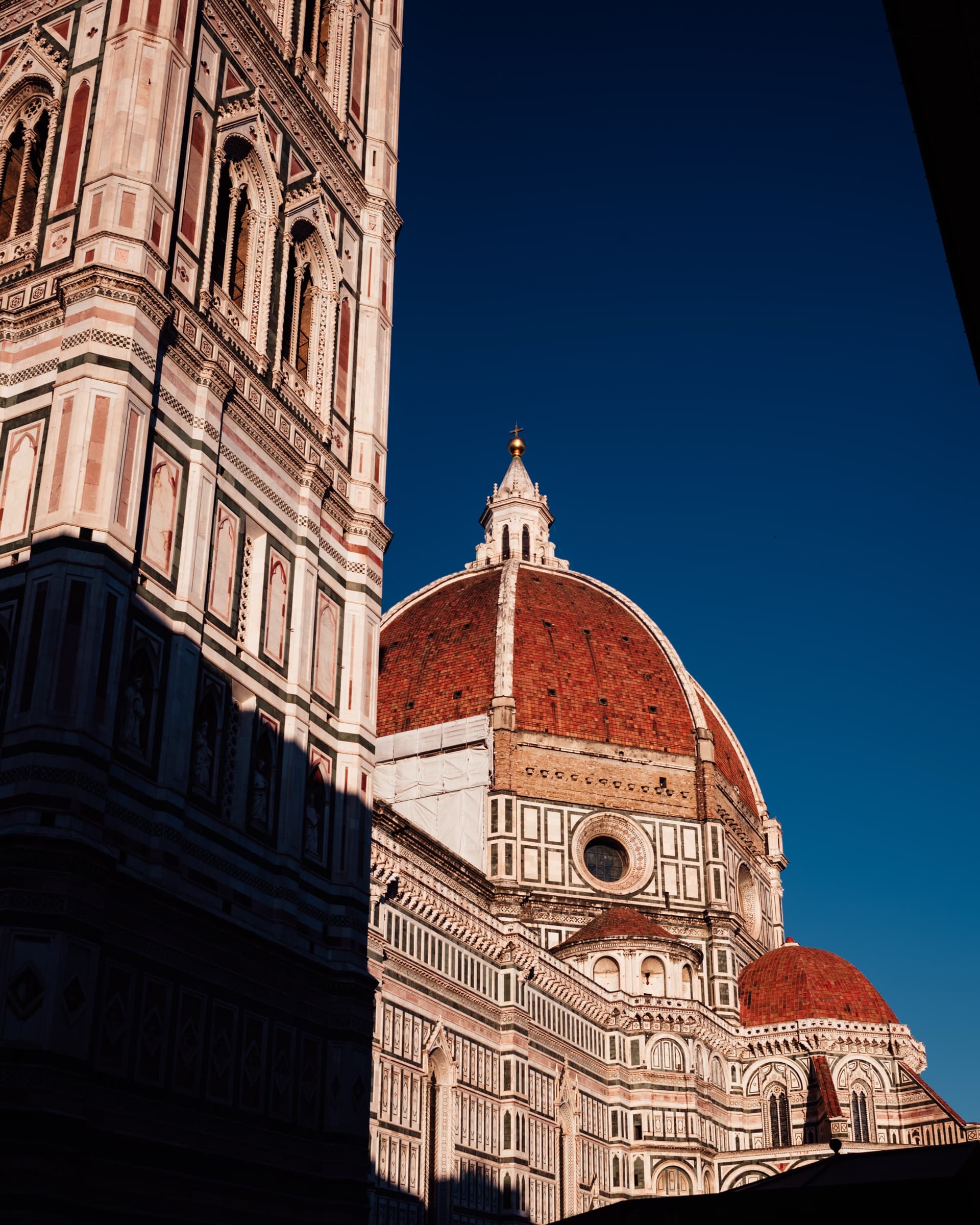
Florence's historic centre is small enough to cross on foot in about 20 minutes, and dense enough to spend a morning doing it slowly. This walk follows the city's medieval spine — from the Duomo south to the river and back through the market squares — treating the great monuments as waypoints rather than ticketed stops. The whole core is a UNESCO World Heritage Site, inscribed in 1982 for six centuries of art built on a Roman street grid (UNESCO). Reckon on an hour and a half at a wander, longer if you stop.
This is the unhurried version, and one of our Florence guides. To see the David, the Uffizi, and the inside of the Duomo properly, with timed tickets, the one day in Florence and three days in Florence plans do the logistics; this guide is about the streets between them. For the south bank, its sibling is the Oltrarno neighbourhood walk.
A few notes before you set off: the route is almost entirely pedestrian and flat, though the streets are cobbled, and nothing on it needs a ticket unless you go inside. The spine fills by late morning, so go early or after 5pm for room to walk, and carry a light layer — churches ask for covered shoulders and knees.
Start at the Duomo and the Baptistery
Begin in Piazza del Duomo, where three monuments share one square. Brunelleschi's dome on Santa Maria del Fiore was raised between 1420 and 1436 and is still the largest masonry vault in the world; the climb to the lantern is 463 steps with no lift (Opera del Duomo). For a walk, you don't need to go up — the dome reads best from the square anyway.
Across from the cathedral stands the octagonal Baptistery, with Ghiberti's gilded east doors that Michelangelo is said to have called the "Gates of Paradise" (the originals are in the cathedral museum; the doors on the building are copies). Giotto's bell tower completes the trio. Circle the three, then walk south.
Down the spine: Via dei Calzaiuoli and Orsanmichele
Leave the square on Via dei Calzaiuoli, the straight pedestrian street that has been the city's main artery since Roman times. A few minutes down on the right is Orsanmichele, the strangest church in Florence — a grain market first built as a loggia in 1290, walled in and turned into a church by 1380 (Visit Tuscany).
Look up at its exterior: from 1339 each of the city's major guilds was required to fill a niche with a statue of its patron saint, and over the following century the commissions went to Donatello, Ghiberti, Verrocchio, and Luca della Robbia (Visit Tuscany). The street-level sculpture gallery is free to stand under, and most people walk straight past it.
Piazza della Signoria and the Ponte Vecchio
Via dei Calzaiuoli opens into Piazza della Signoria, the city's open-air sculpture room and seat of government for 700 years. Palazzo Vecchio still works as the town hall and the mayor's office; inside, the Salone dei Cinquecento is the largest hall of its kind in Italy (Comune di Firenze). Out front, the copy of Michelangelo's David stands on the exact spot the original held until it moved to the Accademia in 1873 (Galleria dell'Accademia); beside it, the Loggia dei Lanzi shelters real Renaissance bronzes and marbles at no charge. The Uffizi colonnade runs off the south corner toward the river.
From the loggia it's a five-minute walk down to the Ponte Vecchio, lined with goldsmiths' shops ever since Ferdinando I decreed in 1593 that only jewellers — not the butchers who came before — could trade on it (VisitFlorence). The enclosed Vasari Corridor still runs above the shops, the Medici's private route across the river. It's also the only bridge in Florence the retreating German army left standing in August 1944 (Destination Florence). See it, then turn back into the centre; the walk's quieter half is still to come.
The market squares: Mercato Nuovo and Piazza della Repubblica
Head northwest off the spine to the Mercato Nuovo, the 16th-century loggia market built under Cosimo I. Its mascot is the Porcellino, a bronze boar cast by Pietro Tacca in 1634; the custom is to rub its snout and drop a coin for luck (Visit Tuscany). The brass nose is polished bright by four centuries of hands.
A block north, Piazza della Repubblica sits on the oldest ground in the city: this was the Roman forum of Florentia, and the column at its centre marks the crossing of the ancient north–south and east–west streets (Visit Tuscany). The grand 19th-century arcades came later, when Florence was briefly Italy's capital.
It's the right place to stop for a coffee; for the algorithm's current top-ranked cafés in the centre:
Cafés in Centro Storico
The medieval east: the Bargello and the Badia
Walk east toward Via del Proconsolo to end where the streets get oldest. The Bargello is housed in the Palazzo del Podestà, begun in 1255 and the oldest public building in Florence; once the city's police headquarters and prison, it opened in 1865 as the new Kingdom of Italy's first national museum and now holds the world's foremost collection of Renaissance sculpture — Donatello's bronze David, works by Michelangelo, Cellini, and Giambologna among them (Musei del Bargello). It's the one interior on this route worth breaking the walk for, and it's almost always quieter than the Accademia or the Uffizi.
Opposite stands the Badia Fiorentina, a Benedictine abbey older than almost everything around it, in the heart of Dante's medieval quarter — the poet's family house, now a small museum, is a minute's walk north. Its slim hexagonal bell tower is one of the skyline's quietest landmarks; step into the cloister if the door is open. Then you've closed the loop, a few minutes back to the Duomo.
That's the core on foot — monuments as waypoints, the city itself as the point. For the best season to walk it, see when to visit Florence.
Frequently asked questions
- How long does the Centro Storico walk take?
- About 1.5 to 2 hours on foot at a wandering pace. The route is barely a kilometre end to end, but the squares, side lanes, and detours are the point — add time if you go inside the Bargello or climb the dome.
- Is Florence's historic centre walkable?
- Yes, entirely. The Centro Storico is a compact, largely pedestrian core — a UNESCO World Heritage Site since 1982 — and you can cross it end to end in roughly 20 minutes (UNESCO).
- Do you need tickets for this walk?
- No. The walk itself is free, following streets and squares. Only the interiors are ticketed — the dome climb, the Bargello, the Uffizi — so for those, book timed entry and see the one-day or three-day plans.