
Guide · Editorial
A walk through Florence's Santa Croce
A self-guided walk through Florence's Santa Croce — the basilica tombs, the leather school, the Calcio Storico square, and the Sant'Ambrogio market.
Published 16 June 2026 · Updated 16 June 2026 · 6 min read
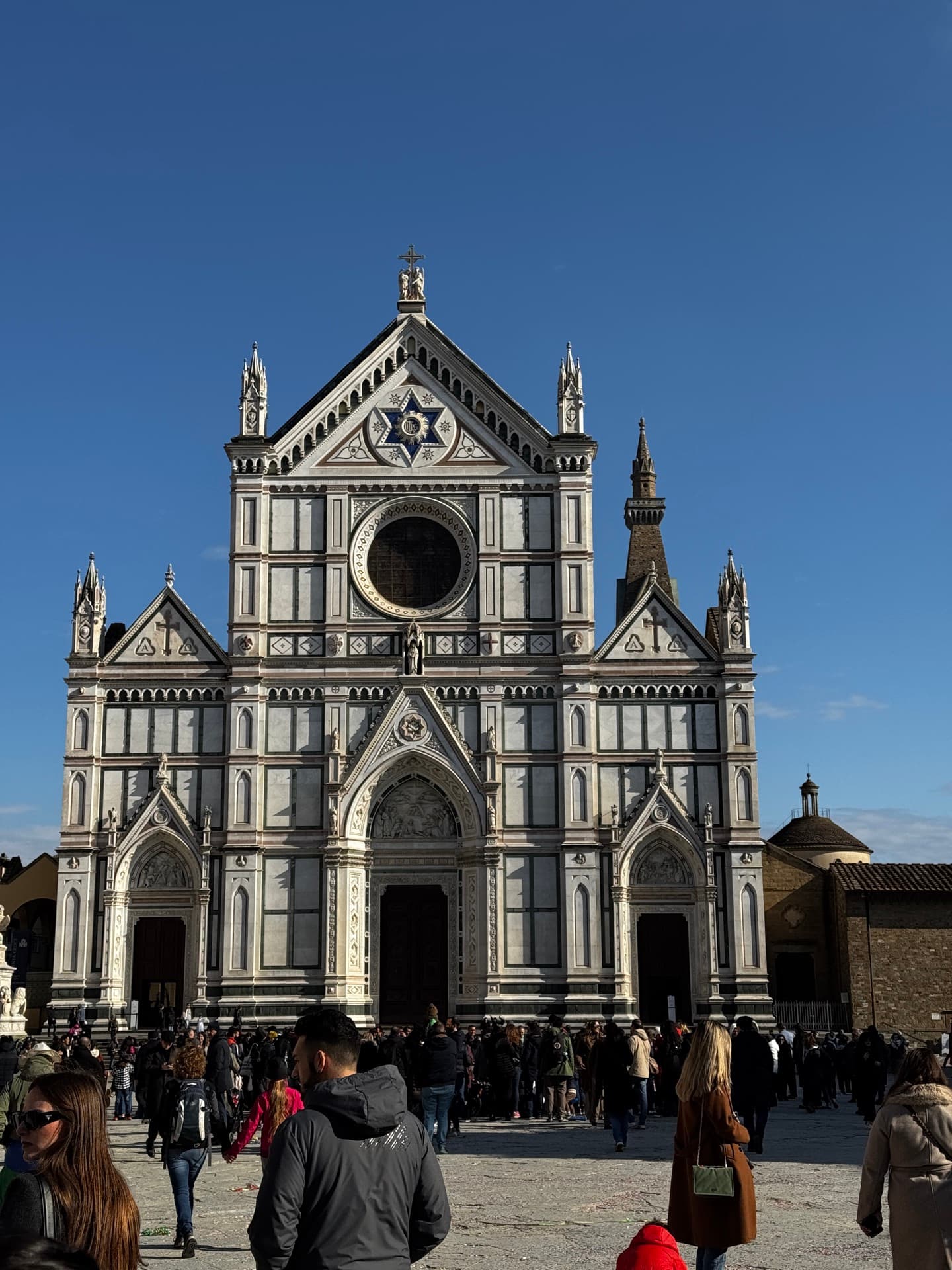
Santa Croce is the quarter Florentines keep for themselves: a vast basilica that doubles as the nation's tomb, a working leather trade, a real food market, and the city's loudest summer festival, all in the streets just east of the tourist core. This walk starts at the basilica, loops the square and the leather workshops, crosses to the Sant'Ambrogio market, and ends among the aperitivo bars — about a kilometre and a half, an easy hour and a half on foot.
It's a wander, not a checklist. To see the headline sights of the centre with timed tickets, the one day in Florence and three days in Florence plans handle the logistics; this is one of our Florence guides about a single quarter on foot. Its siblings are the Centro Storico walk and the Oltrarno neighbourhood walk.
A few notes before you set off: the streets are flat and mostly walkable, the basilica interior is ticketed (the rest of the walk is free), and the Sant'Ambrogio market closes by early afternoon, so go in the morning if the market matters. If you want the Calcio Storico, time your visit to June — see when to visit Florence.
The basilica and its tombs
Start at Santa Croce, the largest Franciscan church in the world, rebuilt for the order from 1294 to a design by Arnolfo di Cambio (Opera di Santa Croce). Inside, it earns its nickname as the "pantheon of Italian genius": the tombs of Michelangelo, Galileo, Machiavelli, the composer Rossini, and the poet Foscolo sit among nearly 300 monuments (Opera di Santa Croce). Dante has a grand cenotaph here too, though he's actually buried in Ravenna, which exiled Florence never got him back.
The art outranks the tombs. Giotto frescoed the Bardi and Peruzzi chapels in the early 1300s, and Brunelleschi designed the serene Pazzi Chapel in the cloister (Opera di Santa Croce). In the refectory hangs Cimabue's 13th-century painted Crucifix — and here the quarter's defining story begins. When the Arno burst its banks before dawn on 4 November 1966, Santa Croce was among the hardest-hit sites; the water rose more than five metres inside, and the Crucifix lost most of its painted surface, the single worst art loss of the disaster (Florence Daily News). The volunteers who waded in to save what they could — students from across the world — were christened the "Mud Angels," and the flood marks are still on the walls if you look.
Piazza Santa Croce and the Calcio Storico
Step back out into Piazza Santa Croce, one of the city's largest squares and, for a few days each June, its rowdiest. The marble-striped façade you're facing is a 19th-century addition; in front of it stands the seated statue of Dante, glaring out over the square.
This is the arena for the Calcio Storico Fiorentino — a brutal, centuries-old hybrid of football and wrestling, fought on sand laid over the piazza. The final falls on 24 June, the feast of Florence's patron saint, with the semifinals on 13–14 June 2026 (Comune di Firenze). Four teams, one for each historic quarter of the city, play in Renaissance colours, and a costumed procession of hundreds winds through the centre to the square before kick-off. The rest of the year the square is calm — café tables, kids on bikes, the occasional market — and a fine place to sit before the next leg.
The leather quarter
Santa Croce is the home of Florence's leather trade, and the place to see it honestly is the Scuola del Cuoio, the leather school tucked into the basilica's former friars' dormitory. It was founded in 1950 by the Gori and Casini families of leather artisans together with the Franciscan friars, set up to teach war orphans a trade in the old monastery corridors (Scuola del Cuoio). You can still watch the cutting and gilding at the benches that line the corridor — its vaulted ceiling frescoed by the school of Ghirlandaio, Medici crests over the doorways (Scuola del Cuoio).
This is the antidote to the souvenir-stall "Florentine leather" sold by the kilo at the San Lorenzo market across town. The workshops in the lanes around Via Torta and Borgo dei Greci are the real trade — repairs, bespoke bags, bookbinding — and most have their doors open to the street.
Casa Buonarroti and the Sant'Ambrogio market
Walk north up Via Ghibellina to Casa Buonarroti, the house Michelangelo bought for his family and now a museum his descendants filled with his work. It holds his two earliest marble reliefs — the Madonna of the Stairs and the Battle of the Centaurs, both carved before he was twenty (Casa Buonarroti). It's small, quiet, and almost never has a queue.
From there it's a few minutes east to the Sant'Ambrogio market, the quarter's working food market — a covered hall of butchers, cheesemongers, and fishmongers ringed by outdoor produce stalls. This is where the neighbourhood actually shops, the un-touristy counterpart to the Mercato Centrale. The cheap-lunch counters inside are the local secret — a plate of fresh pasta or a lampredotto roll, Florence's tripe-sandwich street food, eaten standing at the counter. A block north, Piazza dei Ciompi keeps a small flea market. For the algorithm's current top-ranked places to eat nearby:
Restaurants in Santa Croce
- Restaurant
Bisteccheria Santa Croce - Piazza Santa Croce Firenze
Santa Croce · Florence · 4.8 · 7,743 · Google · €€€
- RESTAURANT
Curry Palace Ristorante indiano a Firenze
Santa Croce · Florence · 4.9 · 1,394 · Google · €€
Aperitivo in Santa Croce
End the walk where the quarter comes alive after dark: the streets between Sant'Ambrogio and Piazza dei Ciompi, where a student and local crowd fills the wine bars from early evening. This is the everyday Florence the monumental centre loses to day-trippers — fuller of residents than visitors once the sun drops, and easier on the wallet for it. On the way, the green dome of the Great Synagogue rises above the rooftops — a 19th-century Moorish-Byzantine landmark and the heart of Florence's Jewish quarter, well worth the short detour.
Find a bar around seven, order a glass and a plate of something, and let the evening settle in. The algorithm's top-ranked wine bars in the quarter:
Wine & bars in Santa Croce
Frequently asked questions
- Is Santa Croce worth visiting?
- Yes — it's one of Florence's most distinctive quarters. The basilica is the burial place of Michelangelo, Galileo, and Machiavelli, the leather trade still works here, and Piazza Santa Croce hosts the June Calcio Storico, all a few minutes east of the museum queues of the centre (Opera di Santa Croce).
- Who is buried in Santa Croce?
- Santa Croce is the 'pantheon of Italian genius,' with the tombs of Michelangelo, Galileo, Machiavelli, the composer Rossini, and the poet Foscolo among nearly 300 monuments. Dante is honoured with a cenotaph here, but he is actually buried in Ravenna (Opera di Santa Croce).
- What is the Sant'Ambrogio market?
- Sant'Ambrogio is the Santa Croce quarter's working food market — a covered hall plus outdoor stalls where Florentines actually shop, and the local, un-touristy alternative to San Lorenzo's Mercato Centrale. It runs in the mornings, Monday to Saturday.