
Guide · Editorial
Lampredotto: Florence's street food, explained honestly
Lampredotto is the tripe sandwich Florentines actually queue for. What it is, how to order it like a local, and the carts verified still serving in 2026.
Published 23 July 2026 · Updated 23 July 2026 · 6 min read
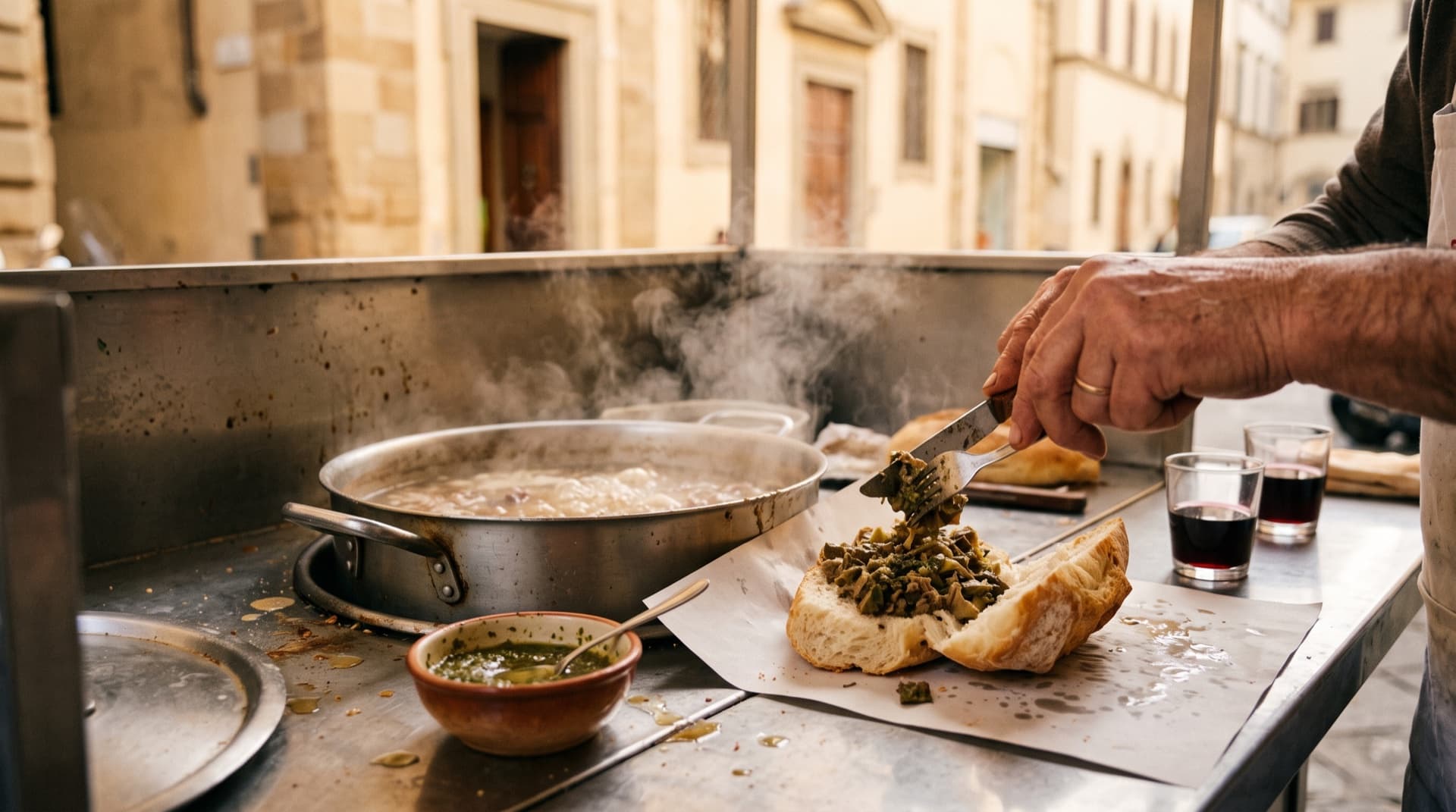
Here's the test of whether you trust a food city: its most beloved street food is a tripe sandwich. Lampredotto — the fourth stomach of the cow, simmered in broth, chopped, and stuffed into a crusty roll — is the thing Florentines themselves queue for at lunchtime, at carts that have been in the same families for generations. It costs around €5, it's eaten standing on the pavement, and yes, it's offal — which is exactly why no one is selling it to you as a photo op. This guide explains what it is, how to order it without hesitating at the counter, and which carts are verified still serving in 2026. It's the street-food chapter of our where to eat in Florence guide.
What it actually is
Lampredotto is the abomasum — the fourth and final stomach of the cow, the only "true" one — and in Florence it is its own dish, separate from trippa. The city is unusual in dividing tripe by stomach: the first three (cuffia, croce, centopelle) are sold as trippa and usually stewed with tomato, while the fourth is lampredotto, boiled slowly in a vegetable broth until tender (Food & Wine Italia; Visit Tuscany). The name is said to come from lampreda — the lamprey, once common in the Arno, which the cooked meat is thought to resemble; it's the traditional explanation rather than a proven one (Treccani; Food & Wine Italia).
The tradition is old and working-class to the bone. Tripe appears in Florentine market records as far back as the fourteenth century, and the trippaio trade as it exists today grew out of nineteenth-century San Frediano, where tripe was boiled near the riverside slaughterhouses and sold from hand-pushed carts that slowly became today's fixed kiosks (Food & Wine Italia; 055firenze). It's still a living trade, not a museum piece: a 2025 survey counted about 50 lampredotto sellers across the city (TroppaTrippa via Gazzettino del Chianti).
How to order like you've done it before
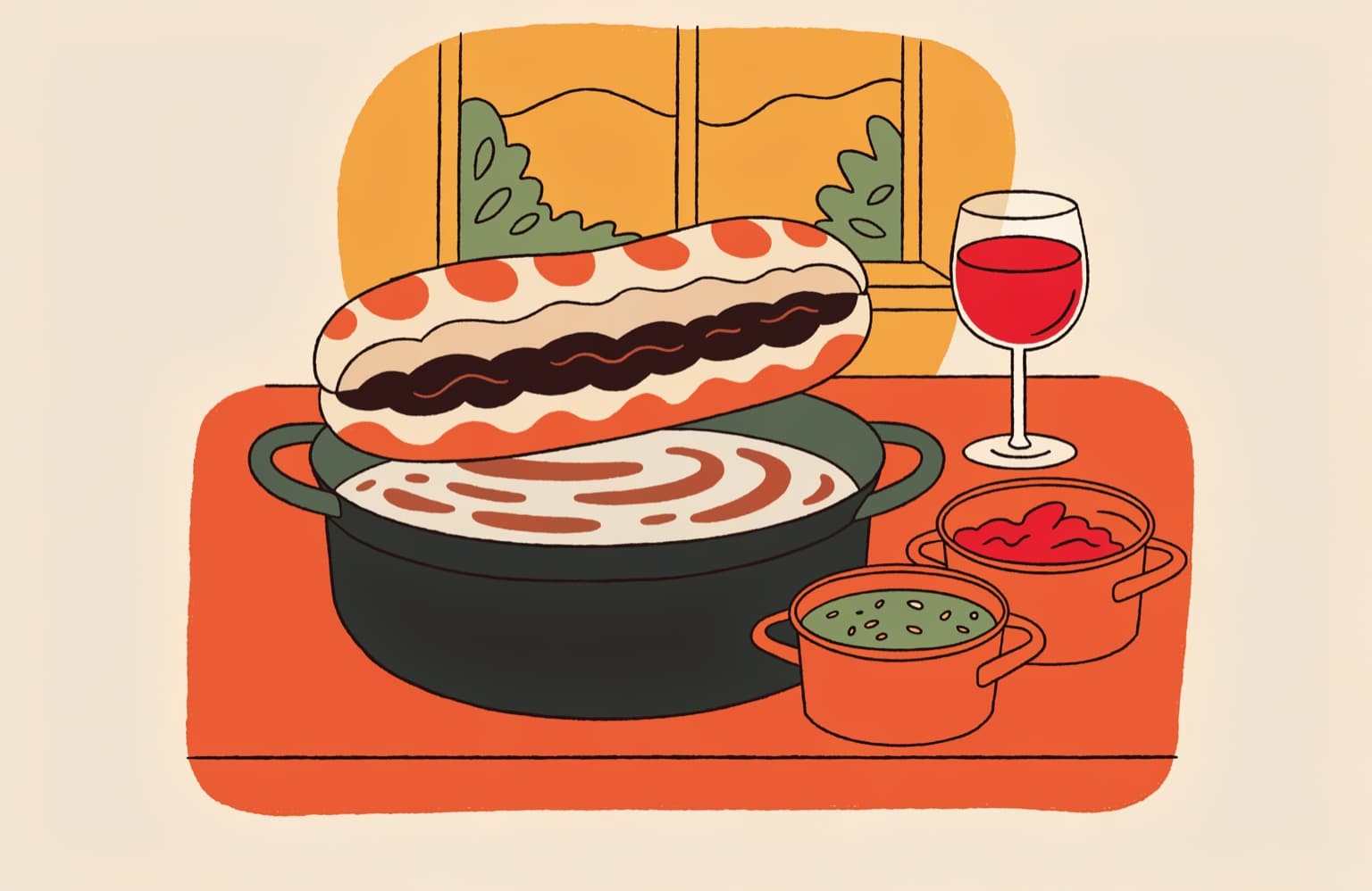
The whole order is one sentence: "Un panino bagnato, con tutte e due le salse." A dipped roll, with both sauces. Here's what each part means:
- The panino — a crusty round roll (the semelle), some of the crumb pulled out to hold more filling. The trippaio lifts the lampredotto steaming from the pot and chops it to order (Visit Tuscany).
- Bagnato — the top half of the bread is dipped in the cooking broth. This is the classic move, not a soggy mistake; say it unless you actively want the bread dry.
- The sauces — salsa verde (parsley, garlic, capers, anchovy) and salsa piccante (chili). Both is the standard answer; the old-school minimum is just salt and pepper (Food & Wine Italia).
- Eat it standing at the cart, ideally with the traditional gottino — a small glass of house red. There are no tables and that's the point.
The carts — verified, 2026
Every cart below was verified operating in 2026 — but these are one-person businesses, so check a cart's social page before crossing town for it (the advice is the same as in August in Florence: the more local the place, the more it lives by its own calendar). No ranking here — each one earns its line differently.
In and around the Mercato Centrale, the two classics sit almost side by side: Da Nerbone, founded in 1872 on the market's ground floor, where you pay the cashier first and then queue (mornings to early afternoon, closed Sunday), and Lupen e Margo outside on Via dell'Ariento, run by Beatrice, one of the city's few trippaie, with a broth that runs redder with tomato (Gambero Rosso; Food & Wine Italia).
In the centre, Da' Vinattieri is the oddity — not a cart but a walk-up window in Via Santa Margherita, steps from Dante's house, handy when you're mid-sightseeing. L'Antico Trippaio on Piazza de' Cimatori, run by the Marchetti brothers, claims the city's first tripe licence and stays open past the lunch rush; Il Trippaio del Porcellino, beside the bronze boar at the Mercato Nuovo, dates its trade to the late nineteenth century, pours house wine by the glass, and sits on the Comune-linked register of historic Florentine businesses (Esercizi Storici Fiorentini; Gambero Rosso).
Two more reward the walk out of the postcard zone. Sergio Pollini Lampredotto, the cart at Via de' Macci 126 near the Sant'Ambrogio market, is a family operation about thirty years old, now carried on by Sergio's son Pierpaolo — and, a point of local pedantry, it is not the same vendor as the tripe stand inside the market itself (Food & Wine Italia; Gambero Rosso). And in the Oltrarno, I' Trippaio di San Frediano on Piazza dei Nerli — Simone Balleggi's kiosk — works the neighbourhood where the whole trade began, serving lampredotto in the roll, on a plate, and in seasonal variations (Gambero Rosso).
Prices and practicalities
Expect around €5, in cash, at lunchtime. The 2025 city survey puts the most common price at €5 and the average at €5.13, ranging from €4 in the outer neighbourhoods to a cheeky €8 at one tourist-centre cart (TroppaTrippa via Gazzettino del Chianti), and nothing in more recent reporting suggests it has moved. The gottino of red adds roughly €1.50. Like the per-etto arithmetic in our bistecca guide, the honest math here is reassuring: this is one of the cheapest real meals in the city.
The rhythm to plan around: trippai are a lunch trade. Most carts open mid-morning and close mid-afternoon when the pot empties; a few centre carts run to early evening. Sundays are mostly off — the Porcellino cart is a common exception — and many take holiday weeks in August, so in high summer check before you go. Carts are cash-first; carry small notes.
If you can't do tripe
No shame in it — and you can still eat at the same counters. Most trippai sell a bollito panino (boiled beef, same broth-and-salsa-verde treatment, no offal), and several add porchetta or wild-boar salumi; Da' Vinattieri's window also does schiacciate and pappa al pomodoro (Gambero Rosso; Food & Wine Italia). Order the bollito bagnato with salsa verde and you get the full ritual, minus the stomach. Then dessert is a short walk in any direction — our gelato guide has the map. Both live with the rest of our Florence guides.
Hungry for the sit-down version of Florence? → where to eat in Florence
Frequently asked questions
- What is lampredotto made of?
- Lampredotto is the abomasum — the fourth and last stomach of the cow — slow-simmered in a vegetable broth and served chopped in a crusty roll. In Florence it's distinct from trippa, which comes from the other three stomachs and is usually cooked with tomato instead (Food & Wine Italia; Visit Tuscany).
- How much does lampredotto cost in Florence?
- Around €5. A 2025 survey of about 50 sellers across Florence found €5 the most common price and €5.13 the city average, with a range from €4 in the neighbourhoods to €8 at one tourist-centre cart (TroppaTrippa via Gazzettino del Chianti). Add roughly €1.50 for the traditional small glass of red. Carts are cash-first, so carry small notes.
- Where do locals eat lampredotto?
- At the trippaio carts and kiosks, standing up: Da Nerbone inside the Mercato Centrale, Lupen e Margo just outside it, Sergio Pollini near Sant'Ambrogio, Da' Vinattieri's window near Dante's house, L'Antico Trippaio on Piazza de' Cimatori, Il Trippaio del Porcellino by the Mercato Nuovo, and I' Trippaio di San Frediano in the Oltrarno — all verified operating in 2026.
- Is lampredotto the same as trippa?
- No, and Florence is unusual in selling them separately. Trippa comes from the first three stomachs and is typically stewed with tomato; lampredotto is only the fourth stomach, boiled in broth and served in a panino. Ask a trippaio for one and you'll get the other only if you point at it (Food & Wine Italia).
Sources and freshness
As observed on 23 July 2026.
- Food & Wine Italia — Lampredotto a Firenze (history, anatomy, the trippai; 14 Mar 2025)
- Visit Tuscany — Tripe and lampredotto (official regional tourism)
- Gazzettino del Chianti — the 2025 lampredotto price survey (TroppaTrippa; Jul 2025)
- Gambero Rosso International — Lampredotto in Florence, where to eat it (8 Jun 2024)
- Treccani — lampredotto (etymology)
- Esercizi Storici Fiorentini — Il Trippaio del Porcellino (historic-business register)
- 055firenze — Trippai fiorentini, storia e curiosità (the cart tradition)